A customer files a warranty claim. They say their product stopped working after eight months. They’ve got the receipt, the model number, and a convincing story. Your support team approves the replacement — after all, it sounds legitimate.
But here’s the problem: without a serial number, you have no way of knowing whether that product is actually covered. Was it purchased from an authorized retailer? Is it still within the warranty window? Did someone already file a claim for this exact unit? You’re making decisions blind, and that’s costing your business real money.
This isn’t a hypothetical scenario. It plays out every single day across product brands that haven’t yet implemented serial number tracking. The cost shows up in three ways: warranty fraud eats into your margins, genuine customers face slower support while your team manually verifies claims, and you lose the ability to spot manufacturing issues before they become a crisis.
Here’s the thing: serial number tracking isn’t just an operational detail. It’s the foundation that turns reactive, guesswork-driven support into a proactive, data-driven system.
What Serial Number Tracking Actually Unlocks
Let’s be clear about what we mean by serial number tracking. It’s not just about assigning numbers to products. It’s about building a digital thread that connects every individual unit — from the factory floor to the customer’s hands to every support interaction that follows.
When you track products by serial number, you can answer questions that would otherwise take hours of investigation: Exactly when was this unit manufactured? Which batch did it come from? Has it been registered before? Is the warranty still active? What’s its complete service history?
My Product Cares makes this possible by giving you a centralized system that handles every stage of the serial number lifecycle.
How It Works: Validation, Lifecycle, and Intelligence
There are three layers to effective serial number tracking, and together they create something far more powerful than a simple database.
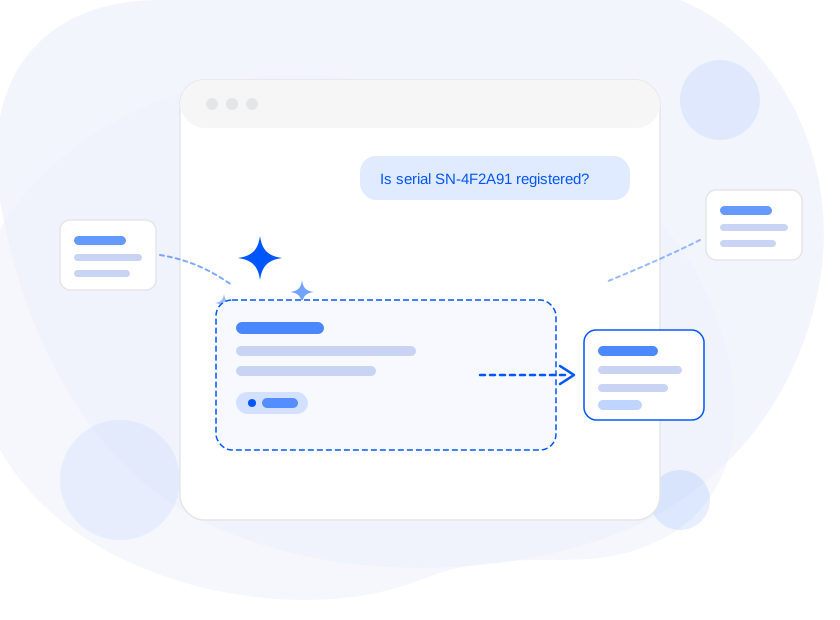
Layer 1: Validation at the point of registration. When a customer enters a serial number on your registration form, the system checks it instantly. Is the format correct? Has this number already been used? Does it match a known product in your inventory? If you enable one-time-use validation, the system prevents the same serial number from being registered twice — eliminating the most common form of warranty abuse.
Layer 2: Full lifecycle tracking. Every interaction tied to a serial number — registration, warranty claim, service request, ownership transfer — is recorded and linked. When a customer contacts support, you pull up their serial number and see the complete picture in seconds. No digging through emails. No “let me check with another department.”
Layer 3: Business intelligence. Serial numbers are a data goldmine. They tell you which product batches generate the most claims, how long your products typically last before needing service, and which manufacturing runs had quality issues. This information feeds directly into product improvement, inventory decisions, and supplier negotiations.
The Capabilities That Matter Most
So what does serial number tracking look like in practice with My Product Cares? Here are the capabilities that brands rely on every day:
Bulk CSV import. You don’t need to enter serial numbers one at a time. Upload a spreadsheet with thousands of serial numbers and their associated SKUs, product IDs, and customer tags in a single step. The system handles format validation and duplicate detection automatically.
Authenticity checker. Give your customers a public lookup tool where they can verify whether a serial number is genuine. This is especially valuable for brands fighting counterfeiting — it turns every customer into a potential counterfeit detector while building trust in your official products.
Downloadable assets per serial number. Link manuals, warranty certificates, setup guides, and firmware updates directly to specific serial numbers. When a customer registers their product, the right documents are delivered automatically. No more “where can I find the manual for my model?” emails.
One-time-use enforcement. Once a serial number is registered, it can’t be used again. This single feature eliminates duplicate claims — the most common form of warranty fraud that costs brands thousands per year.
POS barcode scanning. If you sell through physical retail or at events, your team can scan serial numbers directly at the point of sale using a camera or barcode scanner, attaching them to orders instantly.
REST API access. For brands with existing ERP or manufacturing systems, the API lets you push serial numbers into My Product Cares programmatically. No manual uploads, no CSV exports — just automated data flow.
The Real Business Impact
Let’s talk numbers. Brands that implement serial number tracking consistently report:
Fewer fraudulent claims. When a serial number can only be used once, warranty abuse drops dramatically. One electronics brand using My Product Cares saw duplicate claim attempts fall by over 60% within the first quarter.
Faster support resolution. Instead of the typical back-and-forth — “Can you send a photo of the label?” “What’s the model number?” “When did you buy it?” — support agents find everything they need with one lookup. Resolution times drop from days to minutes.
Smarter recall management. When a specific batch has a defect, you don’t need to notify every customer who ever bought from you. You identify the affected serial numbers, contact only those owners, and handle the recall precisely — protecting your brand reputation while minimizing unnecessary alarm.
Higher registration completion rates. When customers see their serial number validated in real time, they’re more likely to finish the registration form. Clear feedback that says “✓ Valid serial number” builds confidence and reduces abandonment.
Who Needs This? (Hint: More Brands Than You Think)
Serial number tracking isn’t just for electronics. Here’s where it makes the biggest difference:
Consumer electronics and wearables. The most obvious case. High unit value, common warranty claims, and strong counterfeiting risk make serial numbers essential.
Home appliances. Products like blenders, air purifiers, and coffee machines benefit enormously from serial number tracking — especially when extended warranty plans are in play. Know exactly when coverage starts and ends for every unit.
Industrial and commercial equipment. When a single piece of equipment costs thousands and downtime means lost revenue, you need to know the exact service history, warranty status, and manufacturing details for every unit in the field.
Automotive parts and accessories. Regulatory compliance often requires traceability. Serial number tracking gives you the documentation you need while streamlining warranty processing.
Luxury goods and branded accessories. Authentication is everything. A public serial number checker lets customers verify they’ve purchased a genuine product — and it gives you an early warning system for counterfeits appearing in the market.
Getting Started Is Simpler Than You Think
The biggest misconception about serial number tracking is that it requires complex setup. It doesn’t. Here’s the typical path to going live:
- Prepare your serial number data. Export your serial numbers — from manufacturing systems, inventory databases, or spreadsheets — into a CSV with a
serialNumbercolumn. Optionally include SKU, product ID, or customer tags. - Upload in bulk. Import your CSV into My Product Cares in a single step. The system validates formats, flags duplicates, and shows you a summary before anything goes live.
- Enable serial number validation on your registration form. Turn it on in your form settings and decide whether serial numbers should be required, optional, or conditionally required based on product type.
- Customize the experience. Add your serial number lookup URL to your product packaging, set up downloadable assets per serial number, and configure customer-facing status messages.
That’s the entire setup. Most brands go from “we should probably track serial numbers” to “the system is live and validating” in under an hour.
The Bottom Line
Serial number tracking isn’t a luxury feature for enterprise brands. It’s the practical, profit-protecting infrastructure that every product brand deserves. It prevents fraud, speeds up support, gives you data you can actually act on, and — most importantly — shows your customers that you stand behind every single product you sell.
If you’re still processing warranty claims by trusting what customers tell you, or manually searching spreadsheets to verify a product’s history, you’re leaving money on the table and slowing down the very people who keep your customers happy.
Ready to stop guessing and start tracking? Install My Product Cares on your Shopify store and set up serial number tracking today.
Every product has a story. Serial numbers are how you make sure it’s one you can trust.