Picture this: a customer just received their new product from your Shopify store. They’re excited, they open the box, and the first thing they see is a card inviting them to register their purchase for warranty coverage. They head to your registration page, start filling out the form, and then — they hit a field labeled “Serial Number.” They flip the product over, check the box, scan the manual, and still can’t find it. Frustrated, they close the page.
That moment of confusion costs you a registered product, a potential repeat customer, and valuable post-purchase data. But it doesn’t have to be this way. Understanding what a serial number is — and communicating that clearly to your customers — is the first step toward smoother registrations, stronger warranties, and better customer relationships.
What Is a Serial Number?
A serial number is a unique identifier assigned to a single, individual product unit. Think of it as a fingerprint for each item you sell. While a model number identifies the type of product (e.g., “Acme Blender Model 500”) and a SKU or barcode tracks the product for inventory purposes, a serial number identifies the exact unit — the specific blender that left your warehouse and landed in a customer’s kitchen.
To put it simply:
- Model number: What kind of product it is
- SKU / UPC: How you track and sell it in your store
- Serial number: Which specific unit the customer owns
This distinction matters because when a customer files a warranty claim, you don’t just need to know they bought a blender from you. You need to know which blender, when it was manufactured, and whether it’s still within its warranty window. That’s what serial numbers make possible.
Why Do You Need Serial Numbers?
Serial numbers aren’t just technical labels. They unlock capabilities that protect your business and improve the customer experience at the same time.
Warranty tracking and validation. A serial number proves that a specific unit is covered by your warranty. Without one, you’re taking a customer’s word for it — a risky proposition at scale.
Product authentication. Counterfeit products are a growing problem in ecommerce. Serial numbers help you verify that a product returned for warranty is genuinely yours, not a knockoff.
Recall management. If a manufacturing defect affects a specific batch of products, serial numbers let you identify exactly which units need to be recalled — instead of alarming every customer who ever bought from you.
Inventory and lifecycle tracking. Know which batch a unit came from, when it was made, and where it ended up. This data helps you spot quality issues early and manage inventory more accurately.
Customer support efficiency. When a customer contacts you with an issue, asking for their serial number immediately tells you which product they have, when they bought it, and whether they’re covered. Less back-and-forth, faster resolutions.
How to Generate Serial Numbers
You don’t need complex systems to start using serial numbers. The key is consistency and uniqueness. Here are the most common approaches:
Manual prefixes with sequential numbers. The simplest method. Use a prefix that encodes product information (e.g., AM-BL500-) followed by an incrementing number (e.g., AM-BL500-00001). This works for small inventories but becomes error-prone as you scale.
Automated generation through registration apps. This is where apps like My Product Cares come in. Instead of manually creating and tracking serial numbers, the app generates unique serial numbers automatically when customers register their products. No spreadsheets, no duplicate entries, no missed registrations.
Best practices to keep in mind, regardless of your method:
- Keep formats consistent (same length, same separator characters)
- Guarantee uniqueness — never reuse a serial number
- Consider encoding useful info in the prefix (product line, manufacture date)
- Make serial numbers easy to locate and read on the physical product
How to Use Serial Numbers in Product Registration
Serial numbers sit at the heart of the product registration flow. Here’s how they work across the customer journey:
Finding the serial number. Customers typically find serial numbers on a sticker or engraving on the product itself, on the original packaging, or in the product manual. The easier you make it to find, the more registrations you’ll capture. Include a clear instruction card in every box.
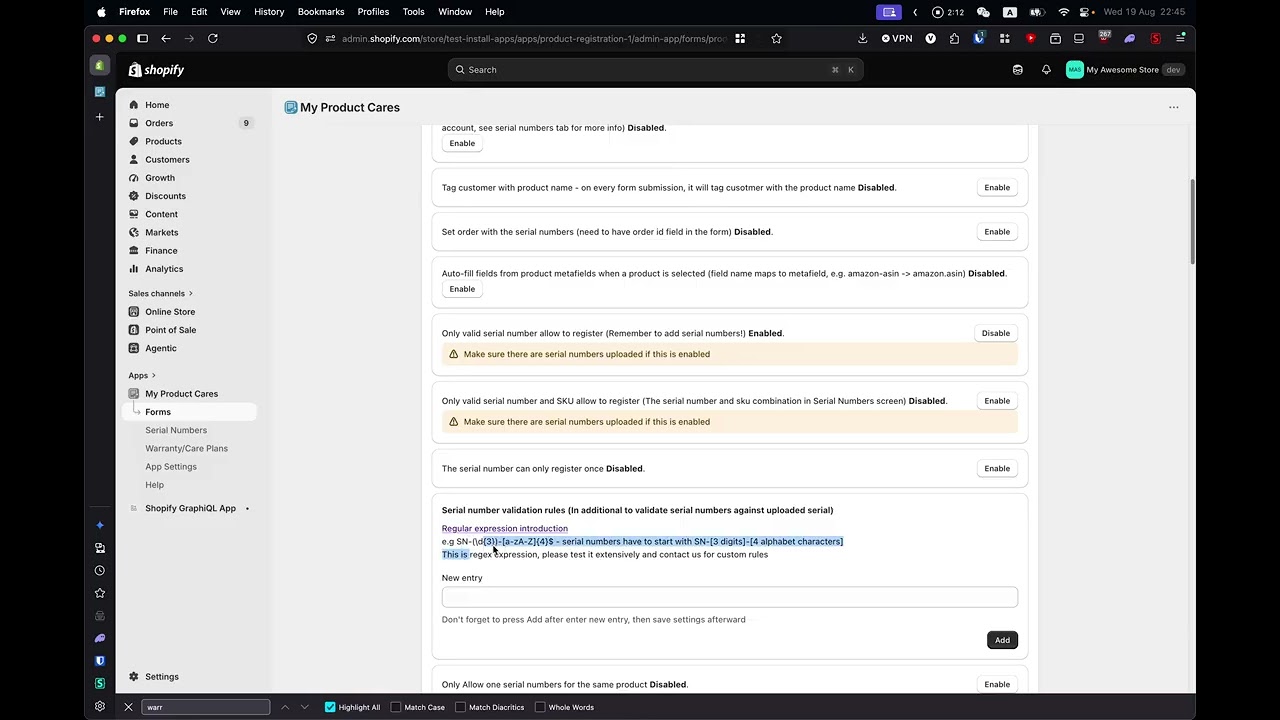
Capturing the serial number. Your registration form should include a serial number field that validates the format in real time. My Product Cares handles this automatically — it checks for duplicates, validates formatting, and alerts customers if something looks off.
Powering warranty claims. Once registered, a serial number links a specific customer to a specific product with a specific warranty. When a claim comes in, you know instantly whether that product is covered, what the warranty terms are, and when coverage expires.
When Are Serial Numbers Essential?
Not every product needs a serial number, but in many scenarios they’re practically mandatory:
- High-value products. Electronics, appliances, tools, and furniture — if a product costs enough that customers expect warranty protection, it needs a serial number.
- Products with warranties. Any product sold with a warranty benefit should have a unique identifier to validate claims.
- Regulated industries. Medical devices, children’s products, automotive parts, and other regulated goods often require serial number tracking by law.
- Subscription or recurring service products. If your product ties to an ongoing service plan or care package, serial numbers connect the physical item to the subscription.
- Products vulnerable to counterfeiting. Luxury goods, branded accessories, and popular consumer electronics all benefit from serial number authentication.
If you sell in any of these categories, serial numbers aren’t just nice to have — they’re essential to your operations.
Key Takeaways
- A serial number uniquely identifies a single product unit — it’s your product’s fingerprint.
- Serial numbers enable warranty validation, anti-counterfeiting, recall management, and faster customer support.
- You can generate serial numbers manually with prefixes and sequences, or automatically with registration apps like My Product Cares.
- Serial numbers are the backbone of a smooth product registration and warranty claims workflow.
- They’re essential for high-value products, warranties, regulated goods, and anti-counterfeiting.
If you’re ready to stop guessing which products are covered and start tracking every unit with confidence, serial numbers are where it starts.
Traceability isn’t just about knowing where your products go — it’s about showing your customers you stand behind every single one.